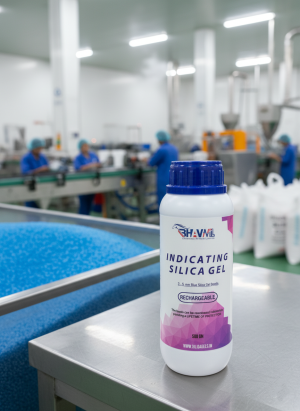
ChemBro Packaging & BhavNil Chemicals Private Limited is a joint venture between ChemBro Packaging and BhavNil Chemicals Private Limited.
Only porous materials with a large specific surface area can be used as adsorbents. The most common substance used to dry air is silica. As sodium silicate is dehydrated, a silica gel is formed. This adsorbent has granule sizes ranging from 0.2 to 7 mm and a specific surface area of 400-770 m2 / g. At the end of its useful life, the moisture level is 9-11 percent. The moisture content of the air is less than 0.02 grammes per kilogramme. The drying process slows as more moisture is absorbed, and then all moisture absorption from the air stops. To restore the absorption properties, it is heated to above 100 ° C or air-dried (150-180 oS temperature).
The method of extracting moisture from the air is complicated by pressures. Adsorbent water vapour forms a concave meniscus within the capillary of an adsorbent. The partial pressure of water over a concave surface is lower than the partial pressure of water over a smooth surface at the same temperature. As a consequence, airborne steam diffuses and condenses in the capillary cavity. The drying temperature is determined by the difference in partial pressures of saturated water vapour between the surface of the meniscus and air-dried.
In manufacturing, there are two types of air-drying devices. A computer with a fixed layer or a machine with a travelling absorption layer. In the first, 75 percent of the adsorbent is constantly in the stream of drying air. The remaining component enters a stream of hot air, where it releases and recovers moisture that has been drained. In the second type of the unit, the adsorbent is stationary: one part absorbs moisture while the other desorbs it. An automatic transition switches between modes after a set period of time.
Visit www.chembropackaging.com and www.silicagels.in for more information.